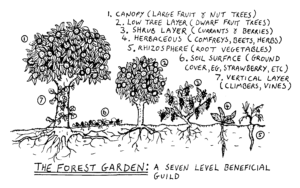
 This year, Regenerative Landscaping teamed up with the volunteers at the Fairview Heights Community Garden at Edgemont Bible Church and Get Up and Go! to start a new food forest as a part of their strategy for expanding their community garden. It’s so exciting to see the transformation from resource-intensive grass to a productive landscape! A food forest is a low-maintenance ecosystem that incorporates the different layers of a forest (e.g. Canopy, Low Tree, Shrub, Herbaceous, Root, Ground Cover, and Vines) to produce food. At the right, you can see a diagram of the seven levels of a food forest.
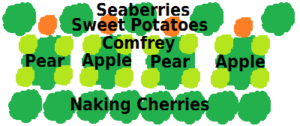 On the left side of the page, here, you can see the basic plan for what we planted. The main fruit trees that will form the canopy of the food forest are Pear and Apple. We also added a row of Seaberry trees, because they fix nitrogen in the ground (much like beans) and they also produce berries that are a super fruit and contain carotenoids which give them their characteristic orange color (like carrots).
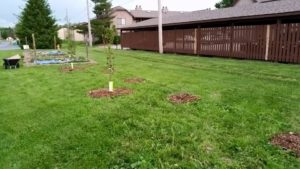 At the right of the page, you can see what the area looked like as we were getting started with planting. A grant from Get Up and Go! paid for the wonderful Pear and Apple trees.
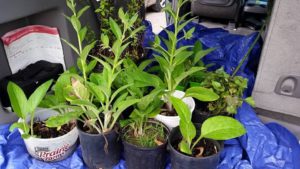 Regenerative Landscaping donated many other plants to fill in the food forest: the Seaberry trees, Naking cherry bushes, Comfrey, Blackberry bushes, and Sweet Potato plants.
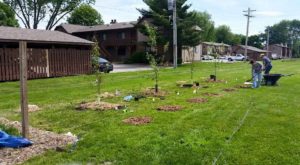 On our first day, the volunteers did a great job of putting in most of the plants. We also mulched enough area around the plants to keep them growing well and minimizing competition with the existing grass.
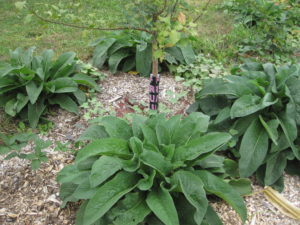
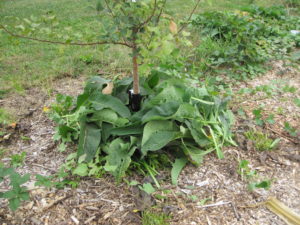
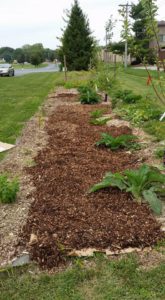 As the summer progressed, we mulched the rest of the area inside the food forest. Eventually, the goal is to shade out most of the ground cover. Until then, wood chips are the preferred choice for ground cover. We also planted four comfrey plants around each fruit tree as a green mulch. Comfrey is a dynamic mineral accumulator as well as a beneficial pollinator attractor. This means that, in addition to attracting pollinators to their fruit trees, it has a deep tap root, so it does not compete with the trees for nutrients but pulls nutrients from deep in the ground to make them available to the trees. They can be chopped and dropped up to eight times a year (pictured below) to create a thick mat of mulch at the base of the tree that provides food for the tree and keeps ground cover from growing and competing with the tree for nutrients and water.
We hope that the Fairview Heights Community Garden’s first food forest will provide perennial food to garden members for many years to come!
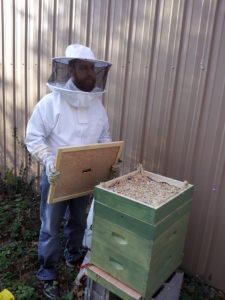
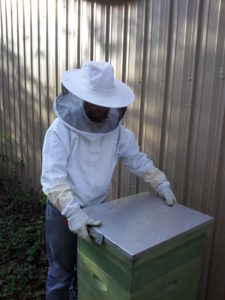
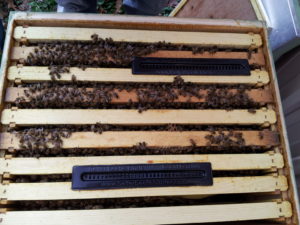 Last week, we winterized our bees for their second winter. There are two main components that we we added to the hives to help them get through the winter.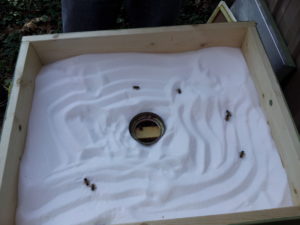
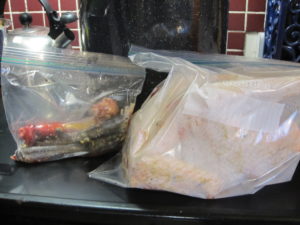
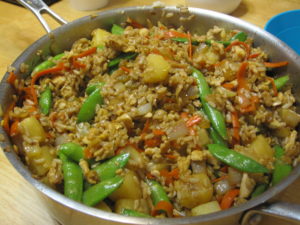 Meal 1: De-breast chicken and use white meat in a meal such as chicken fried rice, pictured below.
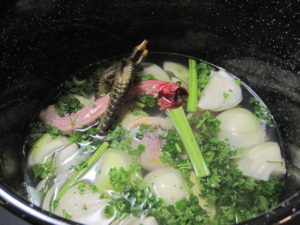 Meal 3: Make chicken stock/broth from the remaining parts (body, neck, and peeled feet). If boiled down long enough, this should produce 14-15 cups of chicken stock/broth. The leftover meat from the body and neck can be combined with the meat to make chicken noodle soup or for another meal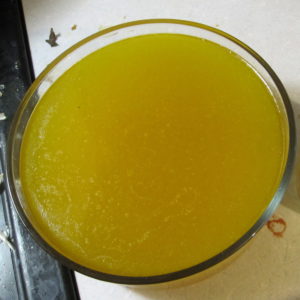
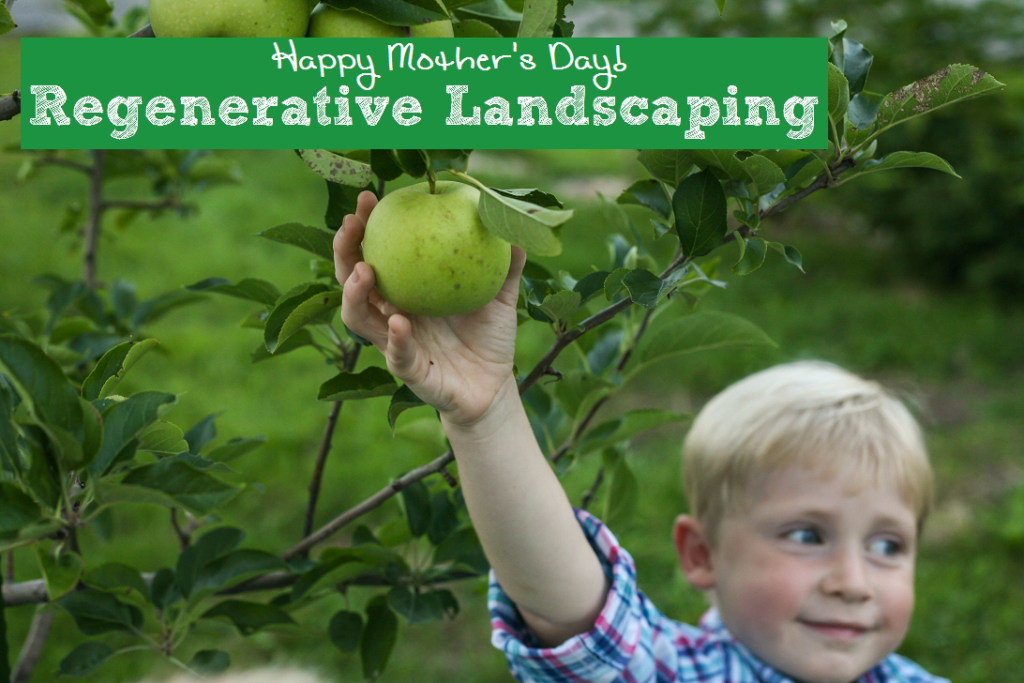 Mother’s Day is right around the corner! Here’s a list of gifts, $50 or less, for a special mom, that will produce year after year:
 I picked up two nucs (nucleus hives) this afternoon to expand our apiary (bee yard). I loaded them both with some extra tag-alongs into my trunk (which is why I kept my bee suit on). If you want to get some weird look, just ride around in town with a bee suit on.
 We started two hives last year, because we read that the survival rate for first year bee keepers is 50%. True to form, we lost one hive this spring. They were alive and flying some of the days in February, but they didn’t have enough stores to make it through the last cold snap at the beginning of March. It was the smaller hive that we picked up last May, so that makes sense. They also didn’t expand as much as the other hive throughout the year.
  The other hive is going strong. We opened them up today and saw lots of maturing brood, so their numbers should be growing a lot in the days to come. For that reason, we went ahead and added a honey super, so they have plenty of room to grow into. You can see that we added a queen excluder (about an inch wide) to the green hive, just above the third hive body, so that the queen won’t lay eggs in the top (fourth) box, and we can harvest honey from it this year! (very exciting!)
 The nucs were driven from Florida yesterday, but they made it safe and sound. I prefer to buy bees raised locally which we did last year, but since my hive died so late in the winter, there weren’t any opportunities for that. It is extremely hard to find bees for sale as late as March. You really need to order bees in January. I also opted to buy nucs instead of bee packages to give them a head start. A bee package comes with a set weight of bees and a queen. They have to start from scratch, building out the comb before they can start laying eggs and expanding the hive. A nuc comes as a small hive, including frames with comb built out on them, eggs and brood, and some honey. As I unpacked the nucs, I checked each frame for the queen, just to put my mind at ease. I did see her in the second nuc but didn’t spot her in the first. I’m not too concerned, though, because there were lots of newly laid eggs in both.
 We installed both nucs, then put some hive beetle traps. They fit in-between the frames and are filled with vegetable oil. The bees can’t fit through the holes of the trap, but they chase the hive beetles through them, where they drown in the oil.
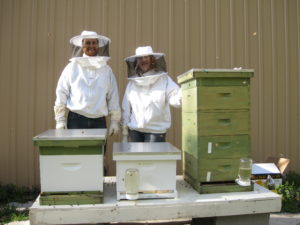 It was a great day to install the bees. They took to the new hives, and we’ll be monitoring their progress with anticipation! Thanks to my Mom for all the help!
 That reminds me that I already have Seaberry and Naking Cherry bushes on order for this spring. I would like to start working with you on designing projects now, so we can order all the rest of the plants that are needed for a thriving/regenerative ecosystem. There are usually short windows that trees can be shipped during the spring, so
 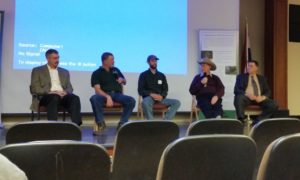 This Thursday, I had a great opportunity to go to the 6th Agroforestry Symposium, hosted by